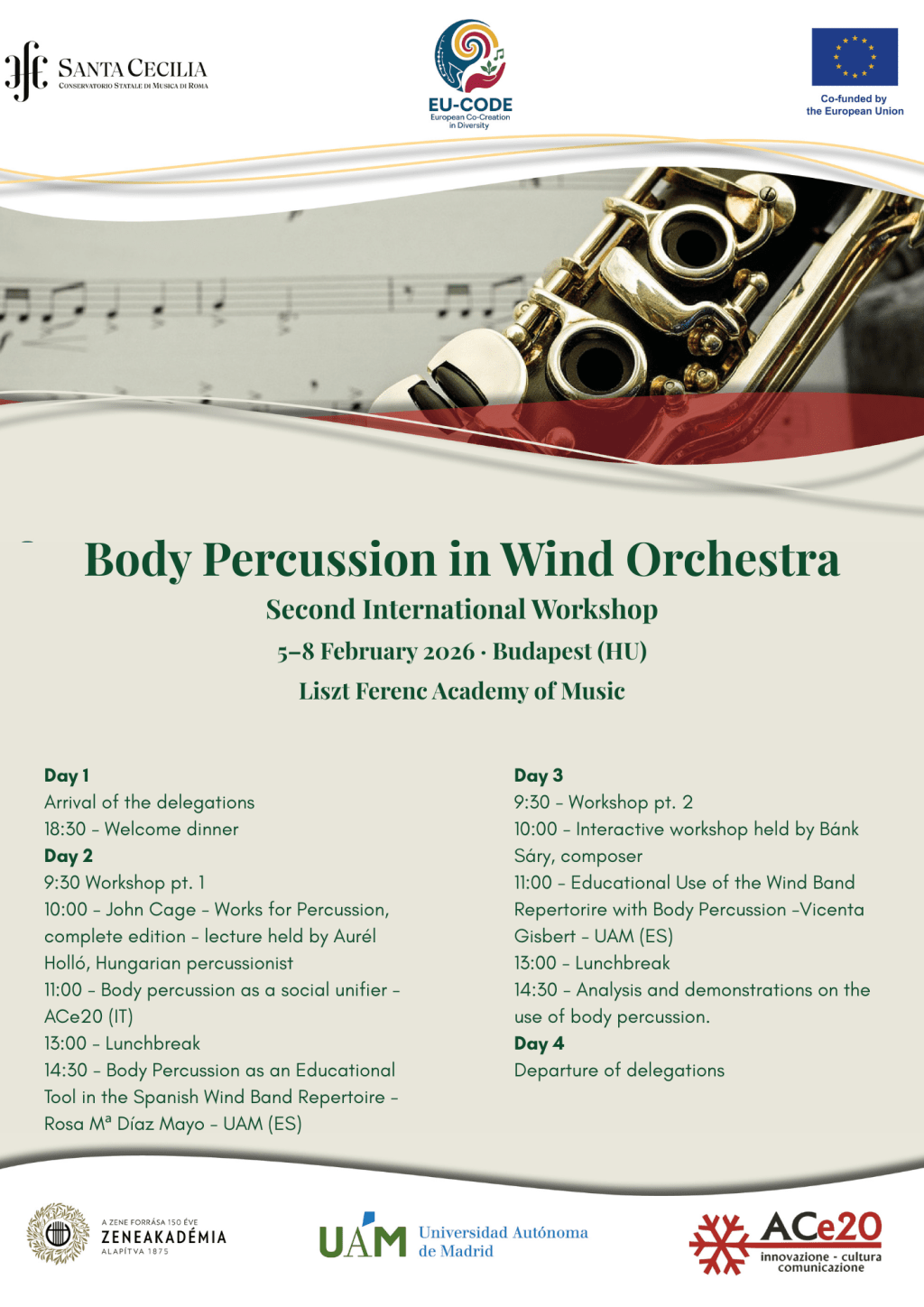
From February 5 to 8, 2026, the Ferenc Liszt Academy of Music in Budapest will host a meeting focused on co-creation, inclusivity, and innovation in the field of wind orchestras. The European band and orchestral scene is going through a period of deep change, and this workshop is designed to address that transformation in a practical and hands-on way.
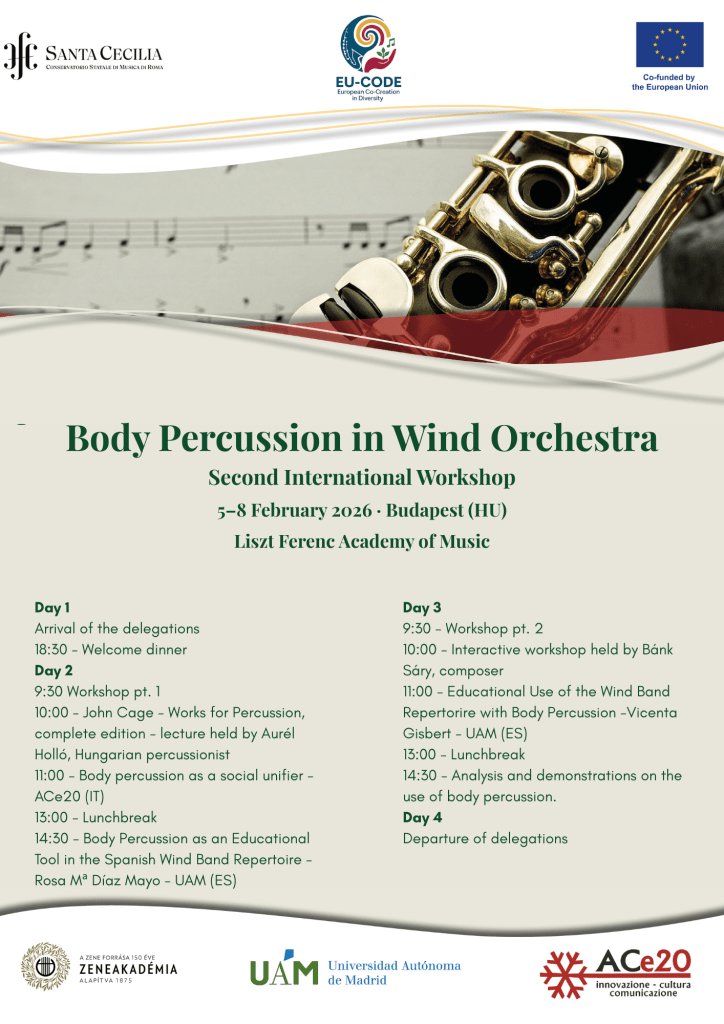
As part of the European Co-Creation in Diversity project, the partner institutions : “Santa Cecilia” Conservatory in Rome, Universidad Autónoma de Madrid, the ACe20 agency, and the Liszt Academy will come together to explore new artistic directions and rethink contemporary musical language. This is not a traditional training course, but a space for experimentation aimed at generating artistic innovation and long-term social impact.
The Budapest workshop represents a key milestone within the EU-CODE project, which seeks to rethink the role of wind orchestras in a constantly evolving cultural context. By combining research, artistic experimentation, and inclusive educational practices, the project aims to respond to the needs of new generations of musicians and audiences. The program functions as a laboratory where new methods are tested and refined, with the goal of making orchestral practices more sustainable over time. Within this framework, the focus on body percussion highlights the intention to expand the expressive and social potential of the orchestra, giving value to the body, movement, and rhythm as tools for collective creation.
The first part of the seminar is dedicated to exploring body percussion as a tool for innovation. Through collaborative activities and guided experimentation, musicians are invited to use the body as an active part of the creative process. The sessions focus on how to integrate these techniques into traditional performances, enriching wind instruments with new rhythmic structures. The main objective is to develop compositional models based on co-creation and shared authorship, while ensuring the inclusion of musicians with diverse backgrounds. Expected outcomes include the production of video materials and the creation of an experimental composition that can serve as a reference for future performance practices.
The second phase of the workshop focuses on consolidating the work carried out. Attention shifts to the development of clear, replicable methods that can be integrated into the long-term artistic planning of the participating institutions. By combining complex rhythmic patterns with harmonic structures, participants develop a more conscious use of gesture and movement as defining elements of orchestral identity. The creation of a methodological handbook and a series of technical tutorials will allow the acquired skills to be shared and will strengthen the long-term impact of the EU-CODE project.
The Budapest workshop confirms EU-CODE as an important driver of change for European wind orchestras. By promoting an open, participatory, and inclusive approach to music-making, the project aligns with contemporary artistic and social dynamics.


 EU-CODE
Lascia un commento