

From November 16 to 23 this year, the Italian capital will host a week of co-creation aimed at innovating band repertoires for greater inclusion and audience engagement.
The European project EU-CODE – European Co-Creation in Diversity is set to launch its First Music Residency, taking place in Rome from November 16 to 23, 2025. This is a crucial and ambitious event: to redefine the sound and performance of European wind orchestras through a radical innovation of their repertoire, specifically with the introduction of body percussion into original compositions.
The objective of the Roman residency is the creation of a shared and innovative repertoire. Central to this revolution is body percussion—the art of producing rhythmic sounds using one’s own body: hands, feet, chest, and fingers. Its role in the EU-CODE project goes beyond simply adding a sound effect; it is viewed as a powerful tool for co-creation and inclusion.
The integration of body percussion opens up significant new opportunities:
-Increased engagement and accessibility: it allows all orchestral members, regardless of their primary instrument, to actively participate in the rhythmic element. This lowers barriers and increases interaction, making the performance experience more democratic and enjoyable.
-Repertoire and performance innovation: it offers composers a new “timbral and rhythmic color” to enrich wind music, which traditionally focuses on melody and harmony. Performances also become more visual and theatrical, adding a dynamic element that captures the audience’s attention, especially younger generations.
-Development of transversal skills: using the body as a musical instrument enhances performers’ coordination, team building, and rhythmic awareness—valuable skills both musically and personally.
In essence, body percussion is the key chosen by EU-CODE to make 21st-century wind orchestras more engaging, current, and representative of Europe’s rich and diverse cultural landscape.
The EU-CODE project is a 30-month collaboration uniting four partners from three European countries. Coordinating the initiative is Italy, with the “Santa Cecilia” Conservatory of Music in Rome, which plays a central role in training and artistic experimentation.
The consortium also benefits from the academic and performative excellence of the Liszt Ferenc Academy of Music in Hungary and the research and analysis expertise of the Universidad Autónoma de Madrid in Spain, which contributes its know-how on diversity and inclusion issues. Completing the picture is the Italian firm ACe20, which not only supports strategic communication but also ensures that all EU-CODE activities are conducted according to sustainable and eco-compatible practices, reflecting the project’s commitment to environmental responsibility.
Together, the partners are working on key themes such as co-creation, artist mobility, and gender equality, with the goal of making wind orchestras more representative of Europe’s rich and varied cultural panorama.
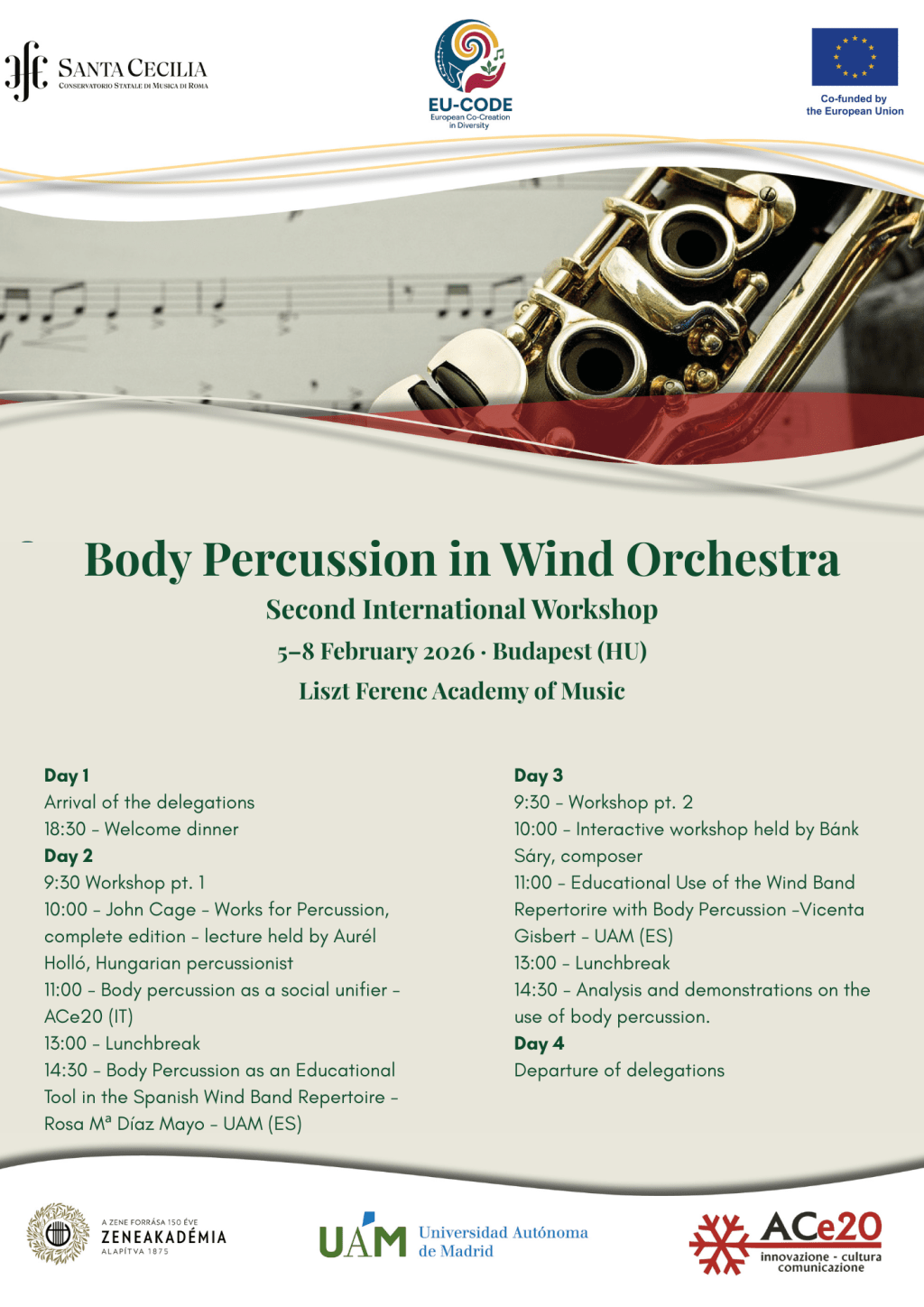

 EU-CODE
Lascia un commento