On September 2026, the Degree Hall of the Faculty of Teacher Training and Education at the Autonomous University of Madrid hosted the workshop titled Inclusion and Diversity in Musical Context. The event represented a key milestone within the framework of the European project EU-CODE (European Co-Creation in Diversity), co-funded by the Creative Europe Programme of the European Union. Ideated and coordinated by the “Santa Cecilia” Conservatory of Music in Rome as the lead beneficiary, the project brings together a prestigious international consortium that includes the Liszt Ferenc Academy of Music in Budapest, the Autonomous University of Madrid, and the cultural organization ACe20. Through EU-CODE, the “Santa Cecilia” Conservatory aims to redefine the landscape of European wind orchestras, transforming them into operational laboratories for artistic co-creation, accessibility, and social integration.
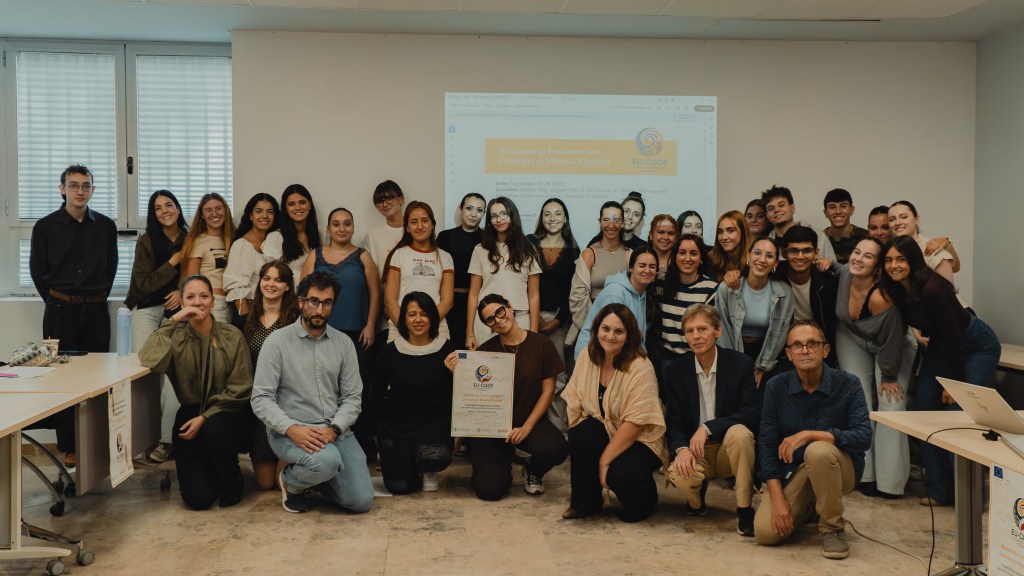
The workshop proceedings opened on Monday, September 28, with a rich programme of academic, pedagogical, and strategic contributions. The opening session featured a presentation by ACe20 delegates Letizia Tessicini, Rosita Ortu, Lavinia Savelli, and Federico Battistoni, titled Mainstreaming Inclusion and Gender Equality. Strategic Project Design and EU Policy Alignment for a Diverse Ecosystem. The paper illustrated how gender mainstreaming and inclusion can be systematically embedded within project design, research methodologies, and daily management practices to ensure full alignment with European Union policy mandates.
The core of the academic and pedagogical discussions was led by the coordinating institution, the “Santa Cecilia” Conservatory of Music in Rome. Maestro Gianfilippo Pocorobba delivered a paper titled The Wind Orchestra as a Device for Social Inclusion and Democratic Pedagogy: Operational Models and Educational Perspectives. Moving beyond the traditional, hierarchical, and eurocentric orchestral framework, the paper redefined the wind ensemble as a heterotopic space where functional, socio-economic, and cultural diversity serves as a generative resource. The intervention detailed the application of Universal Design for Learning (UDL) principles to orchestral scores through symbiotic rewriting techniques and tiered part writing, while addressing the integration of hardware and software assistive technologies—such as MIDI interfaces and eye-tracking systems—and the transformation of the conductor into a community music leader.
The workshop also featured prominent contributions from the host faculty at the Autonomous University of Madrid. Professor Sebastián Izquierdo Leal presented Real-Time Web Technologies for Participatory Music Systems, exploring the application of real-time web tools to facilitate interactive and accessible music-making. Professor Pilar Serrano Betored then delivered a paper titled Gender studies and music education: a possible methodology?, examining the methodological integration of gender studies into contemporary music pedagogy.
In addition to the formal presentations, the workshop provided dedicated working and discussion sessions focused on formulating concrete recommendations for integrating gender mainstreaming into future orchestral programming, alongside the exchange of best practices regarding inclusive music methodologies. The event concluded with a round table and Q&A session, enabling consortium partners and attendees to consolidate the outcomes and advance the shared mission of promoting social equity, accessibility, and democratic participation in music across Europe.


Lascia un commento